Can you get out of a car lease early?
Yes. Almost every lease lets you end it before the last payment. The question is what it costs and who you have to deal with. The Federal Reserve's consumer guide to leasing puts it plainly: ending a lease early can cost several thousand dollars, and the charge can be more than you would have paid by finishing the lease.
So "can I?" is easy. The real question is which exit costs the least for your car, your lender, and your timing. Your lease contract and your lender's current policy decide which doors are open.
Want real numbers on your next car?
Tell us what you're looking for and we'll source your options across 350+ dealer partners. There's no obligation. Or see current New Jersey lease deals.
Your 5 ways out of a car lease, compared
Here is how the options compare. Costs depend on your contract and lender, so treat this as a map, not a quote.
| Exit route | What it costs you | Speed | Best for |
|---|---|---|---|
| Lease transfer (assumption) | Lender transfer and credit-check fees, which vary by lender. Sometimes an incentive to attract a taker. | Depends on finding a qualified taker and on lender processing | A lease with a fair payment that someone else would want, with a lender that allows transfers |
| Sell or trade the car to a dealer or buyer | Nothing extra if the car is worth more than the payoff. You pay the gap if it is worth less. | Often the fastest when the lender allows it | Cars worth close to or more than the payoff, with a lender that allows the buyer you choose |
| Lease buyout | The full payoff, plus sales tax and title/registration costs where they apply | Quick once you have the payoff and the funds | Drivers who want to keep the car, or who have equity and can sell it themselves |
| Early termination through the lender | Remaining lease balance minus what the lender gets for the car, plus fees in your contract. Often the highest cost. | Fast to hand back; the final bill can come weeks to months later | Last resort, or when you have very few payments left |
| Trade into a new lease | Any gap between payoff and value can be rolled into the new deal, which raises your next payment | Fast, because it happens with your next car | Drivers who want a different car now, with little or no negative equity |
| If this is true | Look at this route first |
|---|---|
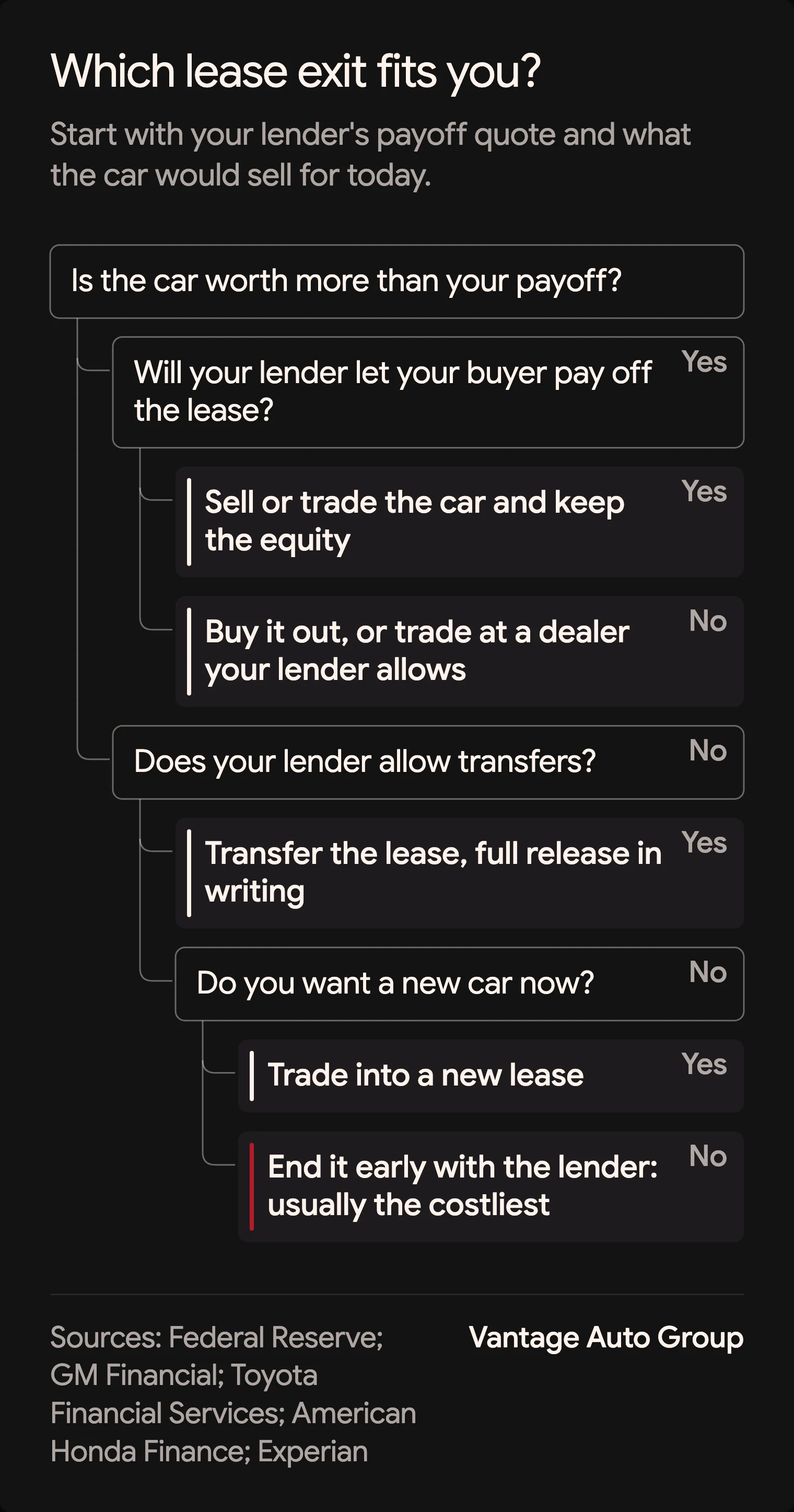
| The car is worth more than your payoff, and your lender lets your buyer pay it off | Sell or trade the car and keep any equity |
| The car is worth more than your payoff, but your lender limits who can buy it | Buy it out, or trade it at a dealer your lender allows |
| The car is worth less than your payoff, and your lender allows transfers | Transfer the lease, with the full release in writing |
| No transfers allowed, and you want a new car now | Trade into a new lease (any gap goes into your new payment) |
| No transfers allowed, and you do not want a new car | Early termination with the lender, usually the costliest route |
1. Lease transfer (lease assumption)
Someone else takes over your remaining payments and term. The new driver has to pass the lender's credit check, and the lender usually charges fees for the transfer. Not every lender allows it: as of Credit Karma's 2023 update, Acura Financial Services and Hyundai Motor Finance did not allow lease swaps, and others limit transfers by state or how far into the lease you are. Ask your lender for its current transfer rules.
The hard part is usually finding the person. Vantage Auto Group can help find and match a qualified driver to take over your lease, then coordinate the transfer with your leasing company and the licensed dealership.
Ask one question before you list your car: will the lender fully release you? Experian notes that some leasing companies still hold the original driver responsible if the new driver stops paying. Get the release terms in writing.
2. Sell or trade the car to a dealer or third party
If your car is worth more than the payoff, a sale can end the lease with money left over. This is where many drivers find equity they did not know they had.
The catch: many captive lenders (the automaker's own finance company) now limit who can buy a leased car. For example, GM Financial says it does "not currently process lease purchase requests through non-GM dealerships." Toyota Financial Services warns that returning the car to a third-party dealer is an "unauthorized third-party vehicle return," and that you stay responsible for the lease until TFS receives the payoff and paperwork. And since 2021, American Honda Finance has told Honda and Acura lessees to "return or trade-in the vehicle to a Honda or Acura dealer only." Many other lenders do not publish a policy at all.
These rules change, and they have changed often in the last few years. Call your lender and ask exactly who can buy the car before you accept any offer. For more on this, see can I sell my leased car?
3. Lease buyout
You pay the lender's payoff amount and the car becomes yours. GM Financial, for example, says you can purchase your vehicle at any point during your lease. After that you can keep it, sell it, or trade it. Expect sales tax and title and registration costs on the purchase where your state charges them.
A buyout makes the most sense when the car is worth more than the payoff, or when you like the car and want to keep it. It does not make sense if the car is worth much less than you would owe.
4. Early termination through the lender
You hand the car back and pay what the contract says you owe. It is simple, but it is usually the most expensive route. With Toyota Financial Services, for example, if you return the car 31 days or more before the lease ends, the final bill can arrive 60 to 120 days after you return it, because the balance may depend on what the car sells for at auction. That means you may not know your exact cost when you drop off the keys.
5. Trade into a new lease
A dealer takes your leased car, pays off the lease, and puts you in a new one. It is fast, and the old lease is settled as part of the new deal. The risk: if you owe more than the car is worth, that gap can be added to your new lease. You pay for your old car inside your new payment. Ask to see the payoff, the value of your car, and any rolled-over amount as separate numbers.
How early termination charges are calculated
The early termination charge is usually the gap between what you still owe on the lease and what the lender gets for the car. The Federal Reserve's leasing guide says it is "typically the difference between the remaining balance on the lease and the amount credited" for the vehicle, plus possible fees such as disposal fees, transfer fees, and taxes. Some lessors add a flat fee on top. The exact formula is written in your lease.
When people compare exit routes, three numbers matter:
- Remaining payments. The monthly payments left on the contract. Useful as a gut check, but most leases do not simply bill you for all of them.
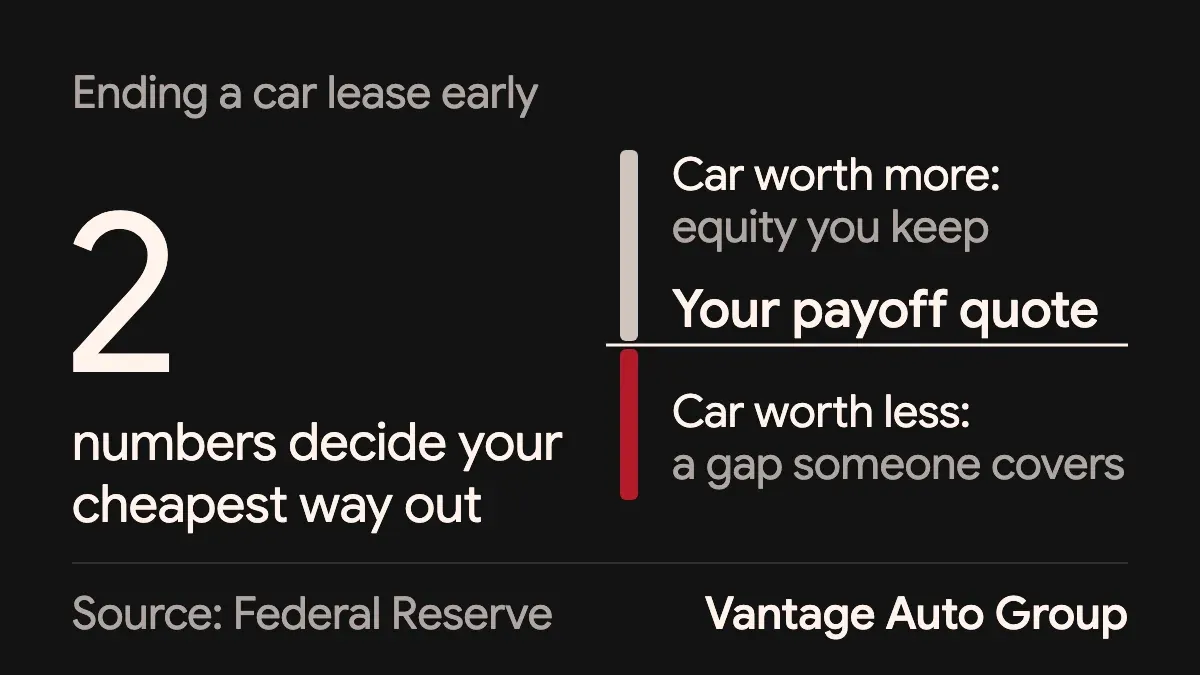
- Payoff (remaining lease balance). What the lender says it takes to close the lease today. It includes the residual value. Ask your lender for this number. It is the starting point for every route.
- Market value. What the car would actually sell for today. If it is above the payoff, you have equity. If it is below, you have negative equity, and someone has to cover the gap.
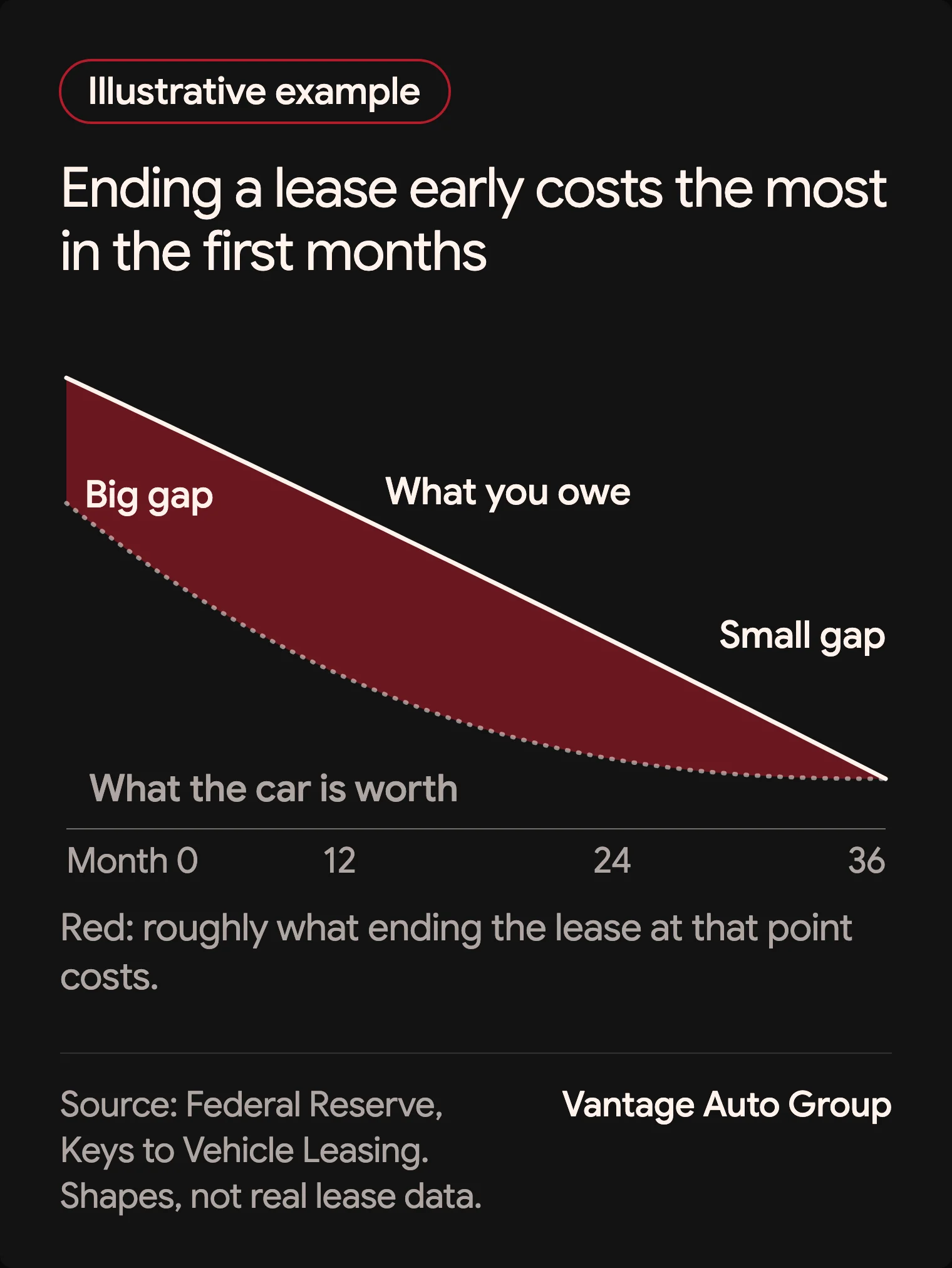
Timing matters too. The Federal Reserve explains that a car's market value "declines more quickly at the beginning of the lease," while early payments do not fully cover that drop. So the earlier you end a lease, the higher the early termination charge is likely to be.
Worked example (illustrative numbers only)
These numbers are made up to show the math. They are not typical figures, and they are not a quote. Your lease and your lender's payoff are what count.
Say you have 15 months left at $450 a month. Your lender quotes a payoff of $26,000.
- Remaining payments: 15 × $450 = $6,750. This is the number that scares people. It is usually not what you actually pay.
- Early termination: You return the car. The lender sells it and credits $22,500. Your charge is about $26,000 − $22,500 = $3,500, plus any fees your contract lists.
- Sell or trade, if your lender allows it: A buyer offers $27,000. That covers the $26,000 payoff with about $1,000 left over before taxes and fees.
- Same car, softer market: If the best offer is $24,500, you owe the $1,500 gap. That is still less than the $3,500 termination charge in this example.
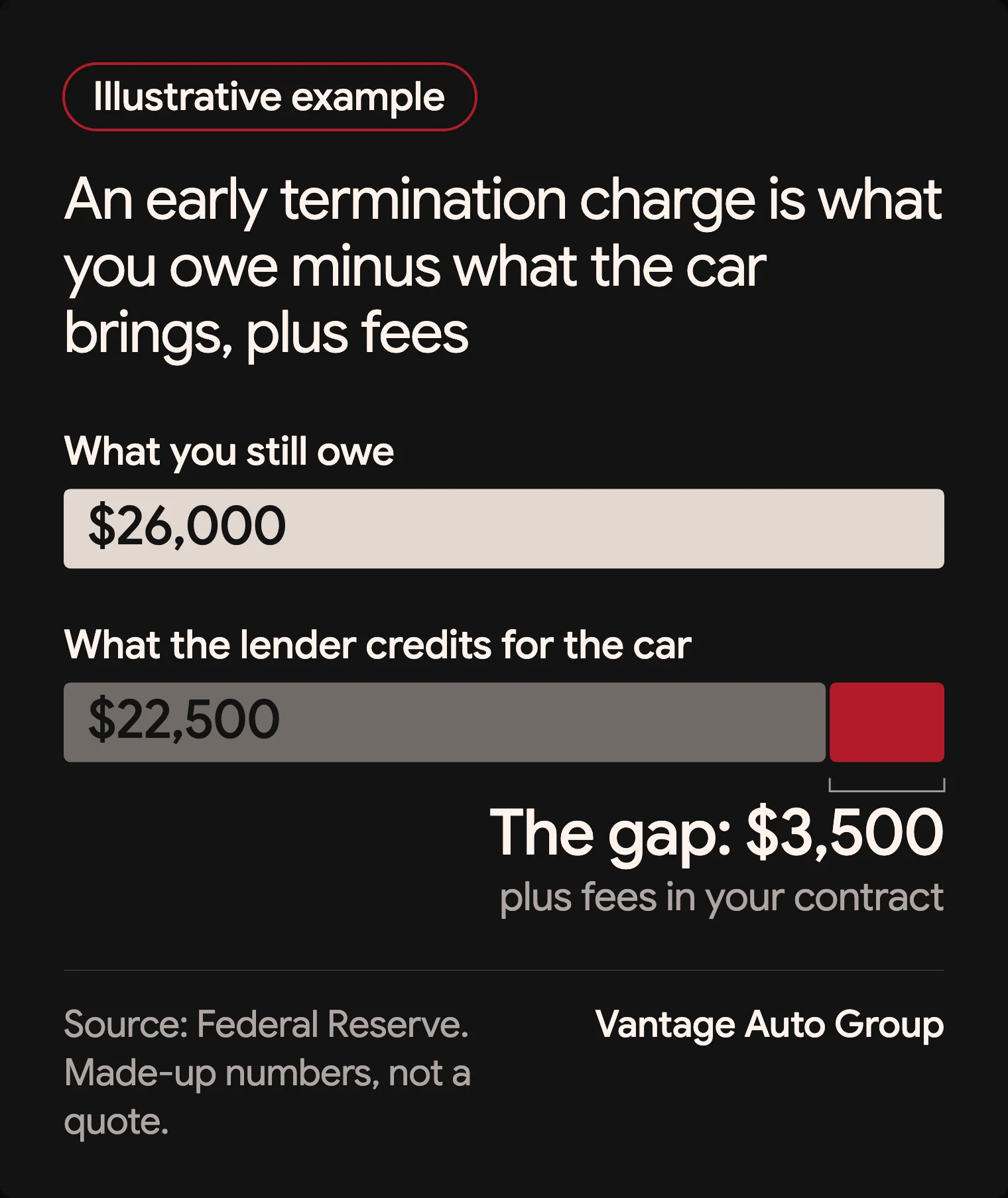
The point: early termination tends to price your car at what the lender gets at auction, while a sale prices it at what a buyer will pay. Always compare those two numbers before you choose.
Not sure which number applies to you? Send us your lender, months left, and mileage. We will pull your options and show any fees before you commit. Get My Exit Plan.
Can you get out of a car lease early without a penalty?
Sometimes. A true no-cost exit happens in a few situations:
- You have equity. If the car is worth more than the payoff and your lender allows the sale, you can leave without paying a gap.
- A transfer with a full release. You may pay only the lender's transfer fees.
- Military service. Under the Servicemembers Civil Relief Act, eligible servicemembers can end a vehicle lease early without early termination charges. Coverage depends on the type and length of orders (generally 180 days or more, or a qualifying deployment), and lease amounts paid in advance for the time after termination must be refunded within 30 days. You still owe taxes, title and registration fees, and reasonable excess wear and mileage charges.
- Lender programs. Automakers sometimes offer early-upgrade ("pull-ahead") offers that waive some remaining payments if you lease a new car from the same brand. These come and go, so ask the lender what is running now.
If none of these fit, the goal is the lowest-cost exit, not a free one.
How to choose the right exit, step by step
- Pull your lease contract. Find the early termination section, the transfer rules, and the purchase option.
- Get a payoff quote from your lender. Ask who is allowed to buy the car: you, a franchised dealer, or any third party.
- Get real offers for the car. Compare them to the payoff to see if you have equity.
- Ask about transfers. Fees, credit rules, and whether you are fully released.
- Add up the total cost of each route, including taxes and fees, and pick the lowest one.
Three habits keep costs down along the way: act early, stay under your mileage limit, and fix small damage before an inspection. Excess miles and wear charges can show up on any route that ends with the car going back to the lender.
Questions to ask your lender before you choose
The steps above already cover the payoff, who may buy the car, and transfer rules. Lender policies differ and change often, so also get these answers from your own leasing company, in writing where you can.
- If I return the car early, how is the charge figured, and when will I get the final bill?With some lenders it arrives weeks or months after you hand back the keys.
- Which other charges apply?Disposition fee, excess mileage, excess wear, taxes and any flat early termination fee.
- Are any early-upgrade offers running now?Some brands waive part of the remaining payments if you lease another of their cars.
- I am a servicemember with orders. How do I use my SCRA rights?Eligible servicemembers can end a vehicle lease early without early termination charges.
Will getting out of a lease early hurt your credit?
It depends on the route. Missed or late payments hurt your credit, so keep paying until the lease is officially closed. A transfer, buyout, or new lease may involve a credit check. A transfer that does not fully release you can leave the lease tied to your name. Paying off the lease as agreed is not a missed payment.
How Vantage Auto Group helps you exit a lease
We assist in negotiating, and we show you the full numbers before you decide anything. Vantage Auto Group is a licensed New Jersey auto broker, and helping drivers get out of leases is part of what we do, even if you did not lease through us.
Here is how it works:
- You tell us your vehicle, lender, months left, and mileage.
- We run the numbers: payoff quote, transfer eligibility, market value, and realistic exit costs.
- We explain your options in plain English and recommend the lowest total cost, least-headache path, and tell you why.
- We itemize any fees before you decide anything.
- If a transfer is the best route, we help find and match someone to take over your lease, and coordinate the transfer with your leasing company and the licensed dealership.
- For a buyout, sale, trade or new lease, we coordinate the payoff and paperwork with your leasing company and the licensed dealership, plus your next car if you want one.
We follow your lender's actual rules and your exact payoff, not dealership guesswork. If a transfer makes more sense than a trade, we will say so.
No pressure, no obligation. We show you the numbers first. Get My Exit Plan