What is the shortest time you can lease a car?
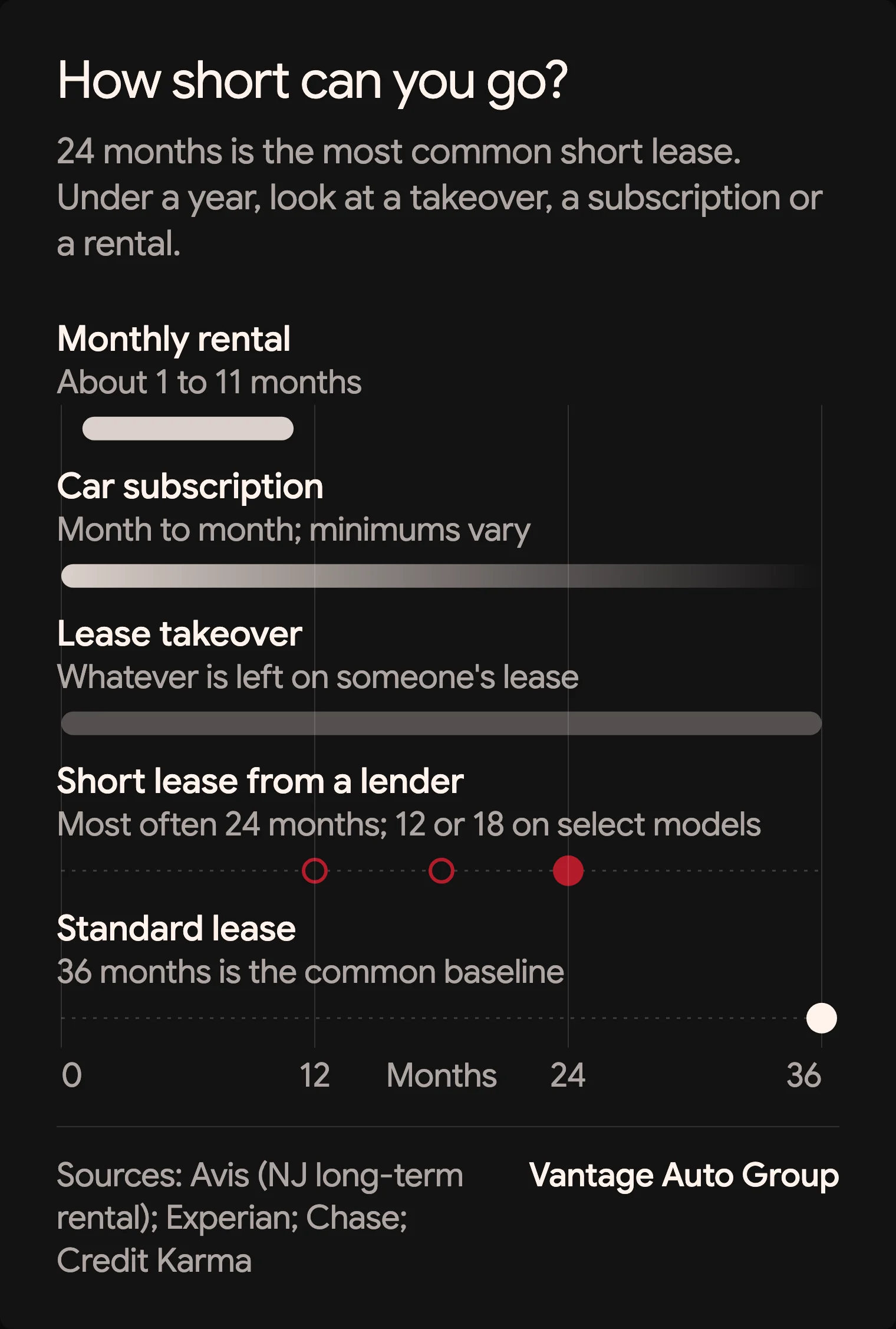
For a brand-new car, the shortest lender term is typically 12 months, but 24 months is the most common short term you'll realistically find. Chase says the shortest lease term is typically 12 months, yet 12- and 18-month programs run only on select models and come and go by brand, model and month. Experian says standard auto leases generally run 24, 36 or 48 months, and Credit Karma notes that at most dealerships 24 months may be the shortest term available.
A true month-to-month car lease doesn't really exist. Chase puts it plainly: if you want to lease a car for a month, "this is not really an option." For anything under a year, you are looking at a lease takeover, a subscription or a rental.

Want real numbers on your next car?
Tell us what you're looking for and we'll source your options across 350+ dealer partners. There's no obligation.
Short-term car lease options compared
Here is how the five real options stack up. "Cost profile" is relative, because the actual number depends on the car, your credit and the month.
| Option | Typical term | Cost profile | Mileage | Commitment | Best for |
|---|---|---|---|---|---|
| Standard lease (baseline) | 36 months | Lowest monthly payment of the lease options | Set annual allowance, chosen at signing | Full term, credit approval required | Staying put for three years |
| Short lease from a lender | Most often 24 months (12–18 on select programs) | Higher monthly payment; fees and tax spread over fewer months | Set annual allowance | Full term, credit approval required | Needing a new car for about two years |
| Lease takeover (transfer) | Whatever is left on someone's lease, from a few months to a few years | You inherit their payment; transfer and credit fees apply | Whatever is left on their allowance | Remaining term only, credit approval by the leasing company | Shortest real lease commitment |
| Car subscription | Month to month, often with a minimum | Highest monthly price; usually bundles insurance and maintenance | Monthly allowance set by the program | Low, but cancellation and swap rules vary | Wanting one all-in bill and short notice to cancel |
| Monthly rental | About a month up to 11 months | High per month; no upfront lease fees | Often unlimited on long-term rentals | Lowest; you can usually return it | Under-a-year needs, gap periods, temporary moves |
Why shorter leases cost more each month
A lease payment mostly covers the car's drop in value while you drive it. A new car loses value fastest early on, and a short lease packs that early drop into fewer payments. Experian notes that longer lease terms translate to lower monthly payments.
Fees work the same way. The acquisition fee and other upfront charges get spread over 24 payments instead of 36. And short leases can be expensive to get out of early. Credit Karma warns that charges for ending a lease early can be high.
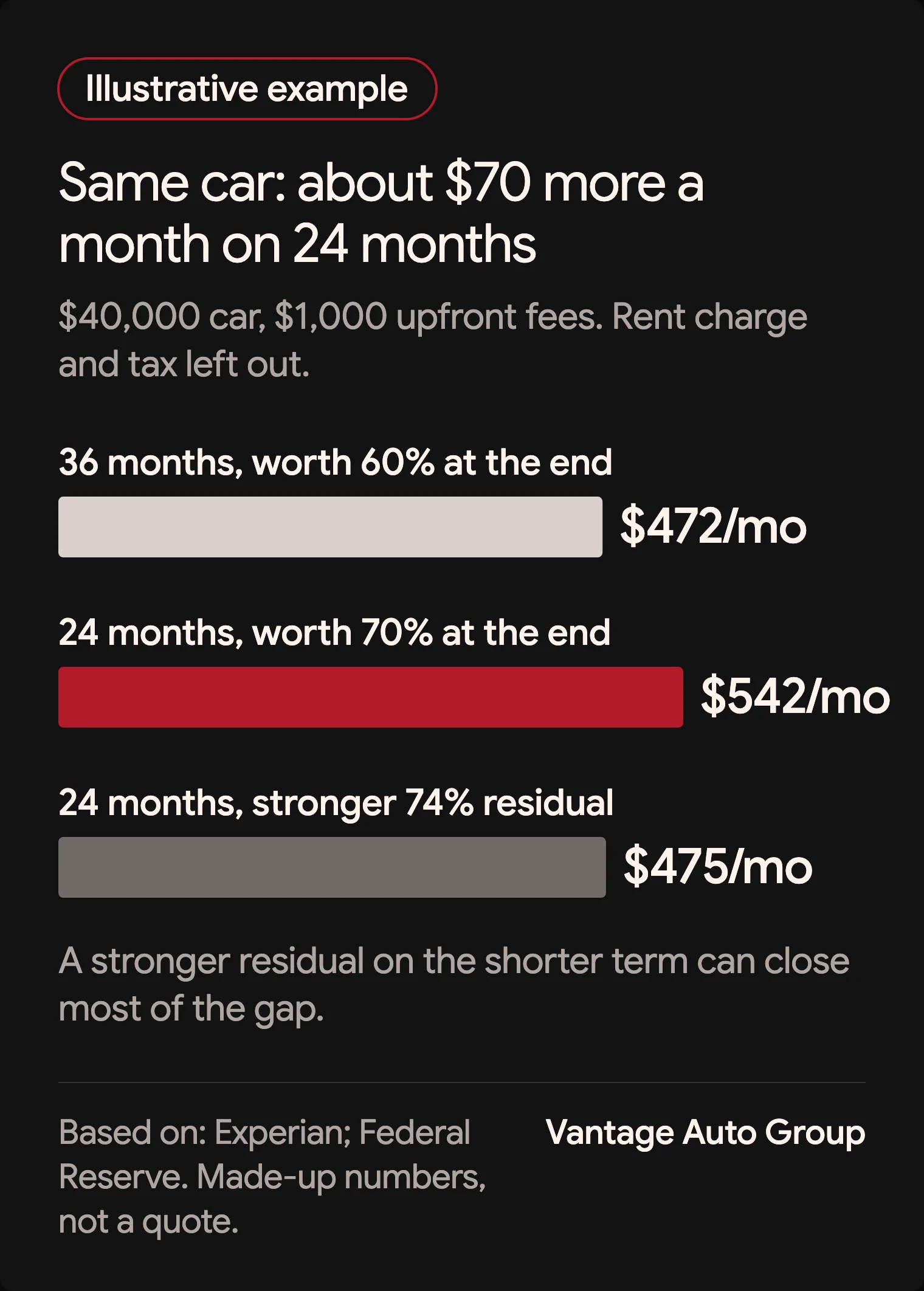
A 24-month lease is not always a bad deal, though. The residual value is set by the leasing company at the start of the lease, which for most new cars is the brand's own captive lender. When that lender sets a strong residual at 24 months, or a brand puts incentives on the shorter term that month, the gap can shrink a lot. You only know by pricing both terms on the same car. That is the comparison we run for clients.
| Illustrative example | Value at lease end | Value drop per month | Fees per month | About per month |
|---|---|---|---|---|
| 36-month lease | $24,000 (60%) | $444 | $28 | $472 |
| 24-month lease | $28,000 (70%) | $500 | $42 | $542 |
| 24-month lease, stronger residual | $29,600 (74%) | $433 | $42 | $475 |
The New Jersey tax wrinkle
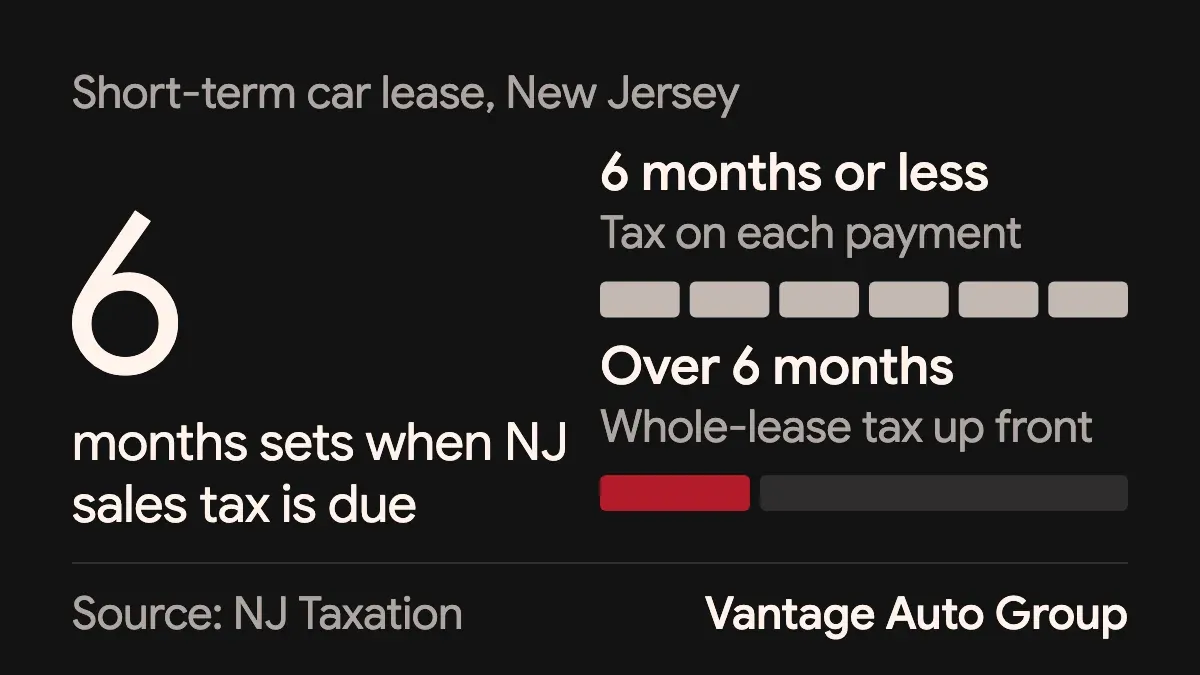
In New Jersey, the length of the lease decides when sales tax is due. For leases longer than six months, sales tax is due on the entire lease amount at the beginning of the lease, according to the NJ Division of Taxation. For leases of six months or less, tax is due on each payment. The tax is often rolled into the monthly payment, but it is calculated on the whole lease up front, so ask to see the tax-inclusive number before you sign.
Option 1: A short lease from a lender (usually 24 months)
This is the cleanest option if you want a new car for about two years. You get a full manufacturer warranty, a car nobody else has driven, and a fixed end date. Brands do advertise 24-month terms: Kelley Blue Book's November 2026 roundup listed 24-month lease offers on the Hyundai Sonata and the Kia Sportage, for example. The catch is that not every brand or model offers a 24-month program every month, and the payment will usually be higher than on a 36-month lease for the same car.
From the broker side, this is where shopping across brands matters most. One lender may support a short term on a model this month, and another may not offer it at all. A single dealership can only show you its own brand's programs. A broker can check short-term programs across many brands at once and tell you which cars actually price well at 24 months. To see what is available right now, browse our current car lease deals in New Jersey.
Option 2: Take over someone else's lease
A lease takeover (also called a lease transfer or lease swap) is the only way to get a lease shorter than about a year. You step into another driver's lease for the months they have left. Experian notes this can mean leasing a car for six months, three months or even less. Marketplaces like LeaseTrader and Swapalease list these cars.
What a takeover really involves:
- The leasing company has to approve you. Credit Karma explains that the person taking over generally needs to meet the same credit standards the original lessee met. This is subject to credit approval, just like a new lease.
- Not every lender allows it. As of Credit Karma's 2023 update, Acura Financial Services and Hyundai Motor Finance don't allow lease swaps, and others block transfers near the end of a lease. Policies change, so confirm with the leasing company first.
- You inherit their deal. That includes their payment, their remaining miles and the car's current condition. Credit Karma says to note the original lessee's payment, because you'll be inheriting it.
- Expect fees. There is usually a transfer fee from the leasing company, and marketplaces charge their own listing or service fees. Ask for every fee in writing before you commit.
Watch the remaining miles closely. If the original driver used most of the allowance, you could owe excess-mileage charges at turn-in, which Credit Karma says typically run 10 to 25 cents per mile.
Vantage can match you with a driver who is trying to exit a lease early, and coordinate the transfer with the leasing company and the licensed dealership. If you are on the other side and want out of your own lease, our guide on how to exit a car lease early walks through transfers, buyouts and the rest.
Option 3: A car subscription
A subscription gives you a car for a monthly fee, often with insurance and maintenance bundled in. Experian describes subscription services that let you drive any vehicle on a month-to-month basis, and the fee may include maintenance and insurance.
Two honest caveats. First, availability changes often and is usually city by city, so check whether a service actually operates where you live in New Jersey before you plan around it. Second, the all-in price is usually higher than a lease payment, because you are paying for flexibility, insurance and maintenance in one bill. When Enterprise launched its subscription in 2019, the monthly fee covered up to 3,000 miles per month, maintenance, roadside assistance, and damage and liability protection, in just three states. Compare the full monthly cost against a lease payment plus your own insurance before deciding.
Option 4: A monthly rental
If you need a car for less than a year and don't want a credit review, a long-term rental is often the simplest answer. Enterprise says long-term rental rates begin with rentals of more than 28 days, with no mileage limit on most vehicle classes. Avis offers New Jersey rentals for terms of 1 to 11 months, with no long-term commitment.
The tradeoff is cost and the car itself. Monthly rental rates add up quickly over many months, and you get whatever is in the fleet, not a car you chose. Credit Karma notes that renting usually needs only a credit or debit card, while leasing involves a credit review and "simply giving the car back and stopping payments is not an option."
Which short-term option fits you?
- Under 6 months: a monthly rental, or a lease takeover with only a few months left.
- 6 to 18 months: a lease takeover, a subscription if one serves your area, or a rental if you want zero lock-in.
- About 2 years: a 24-month lease from a lender, or a takeover with about two years left.
- Waiting on a factory order, a move or a job change: match the option to how sure you are about your end date. The less sure you are, the more a rental's walk-away flexibility is worth.
A short-term lease is still a lease. You sign a contract, you are responsible for the car, and getting out early costs money. If your timeline might change, pick the option with the exit you can live with.
How Vantage Auto Group helps with short-term leasing
Vantage Auto Group is a licensed New Jersey auto broker. We work through our dealer-partner network, and we help with short-term leasing in two ways:
- Short lease terms through dealer partners. We check which brands have 24-month (or shorter) programs this month and show you how the short-term number compares to a 36-month one on the same car.
- Lease takeovers. We help find and match you with someone exiting a lease early and coordinate the transfer with the leasing company and the licensed dealership. If you are the one who wants out, we can help find someone to take over yours.
The licensed dealership finalizes the contract and terms, subject to credit approval. You see the full deal breakdown, including what is due at signing, before you commit. And if a rental makes more sense for your timeline, we will tell you.
Not sure which route fits? Request a Quote and tell us how long you need the car. We will come back with the options that actually fit that window.