The short answer: what score you need to lease
Aim for 661 or higher if you want the mainstream of lease programs, and 781 or higher if you want the best chance at the advertised specials. Below 661 you can still lease, but fewer programs fit and the terms get more expensive. Every lender sets its own cutoffs, so these are market patterns, not approval rules.
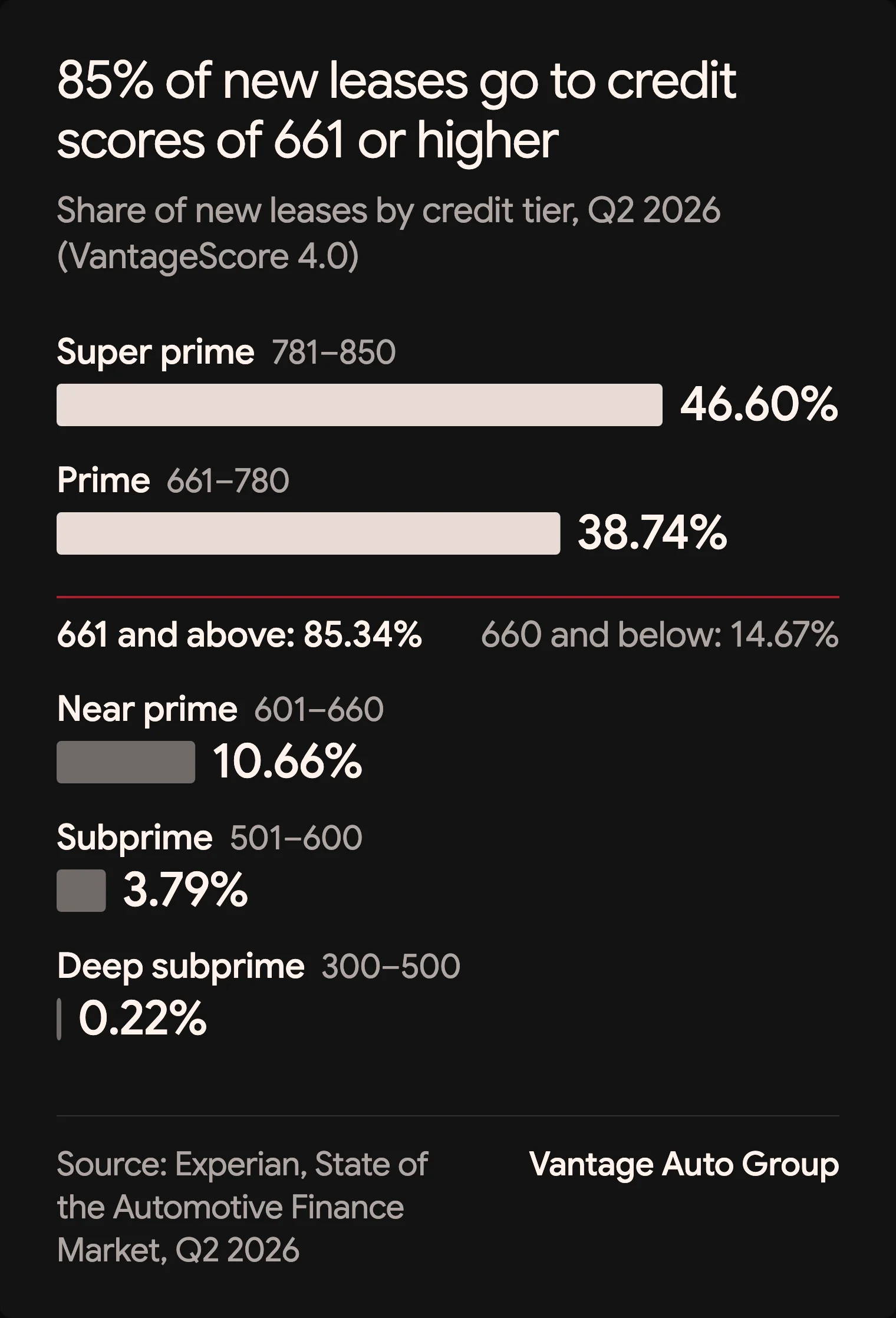
The numbers come from Experian's quarterly State of the Automotive Finance Market report for Q2 2026, the most recent edition published. It is built from vehicle title and credit data and breaks every new lease down by credit tier, using VantageScore 4.0.
Want real numbers on your next car?
Tell us what you're looking for and we'll source your options across 350+ dealer partners. There's no obligation. Or see current New Jersey lease deals.
Lease credit score tiers: the 2026 numbers
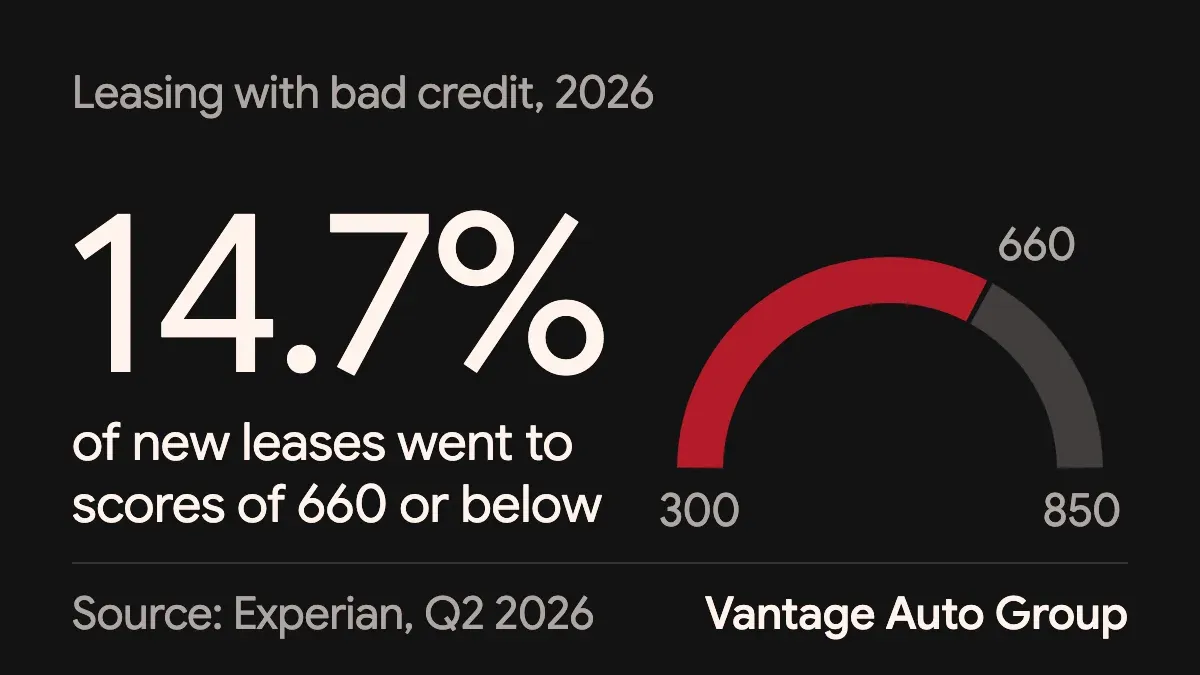
Most people who lease have good to excellent credit, but roughly one new lease in seven went to someone at 660 or below. Here is how new leases split by tier in Q2 2026, with the year before for comparison:
| Experian tier | Score range (VantageScore 4.0) | Share of new leases, Q2 2026 | Share, Q2 2025 | Avg. new lease payment, Q2 2026 | What to expect |
|---|---|---|---|---|---|
| Super prime | 781–850 | 46.60% | 48.29% | $622 | The group advertised specials are built for. Lowest money factors. |
| Prime | 661–780 | 38.74% | 37.98% | $609 | Most programs fit. Toward the low end, the money factor may be above the advertised one. |
| Near prime | 601–660 | 10.66% | 10.06% | $623 | Possible, with a higher money factor and sometimes extra conditions. |
| Subprime | 501–600 | 3.79% | 3.47% | $619 | Many standard programs are hard to qualify for. A strong co-signer is the usual path. |
| Deep subprime | 300–500 | 0.22% | 0.21% | $605 | Rare. Fixing the credit first is usually the better move. |
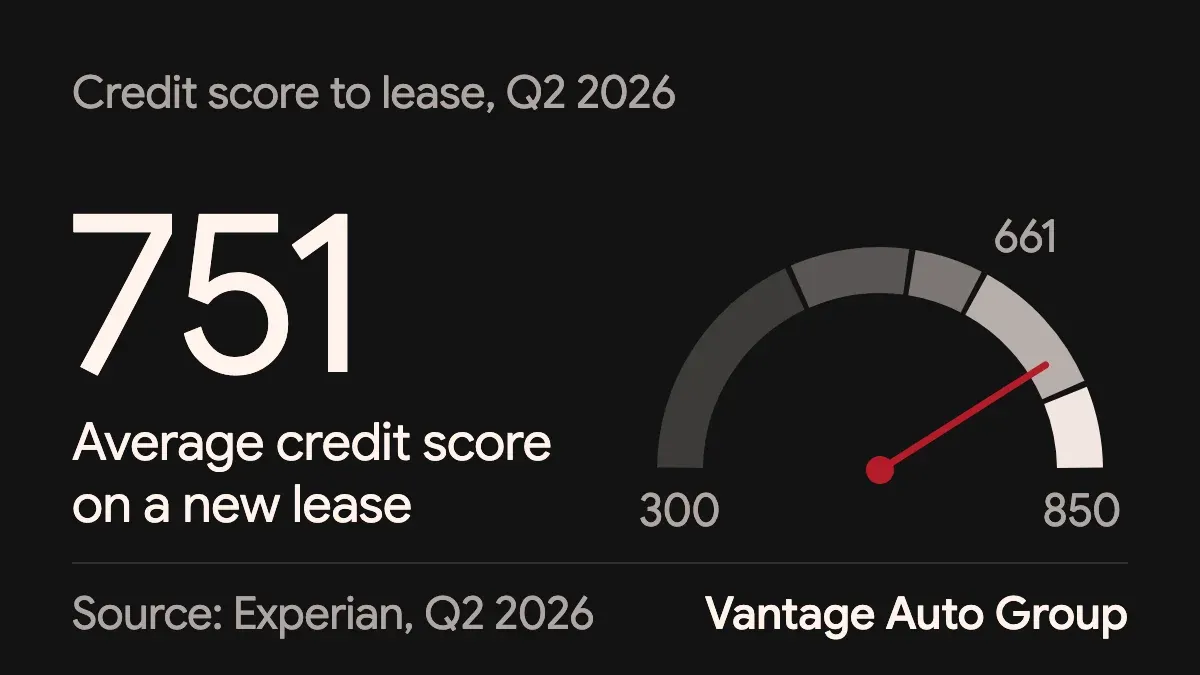
Source: Experian, State of the Automotive Finance Market Q2 2026 (tier ranges, lease share by tier, average payment by tier). The average new-lease score slipped from 753 to 751 over the year, and the near-prime and subprime shares both grew.
Two cautions. First, these are Experian's reporting tiers, not any lender's approval cutoffs. Second, the average payment barely changes from tier to tier, because the payment also depends on which car you lease and how much you pay at signing. Your credit shows up most in the money factor, not in a headline payment.
Can you lease a car with a 680, 650, 620 or 580 credit score?
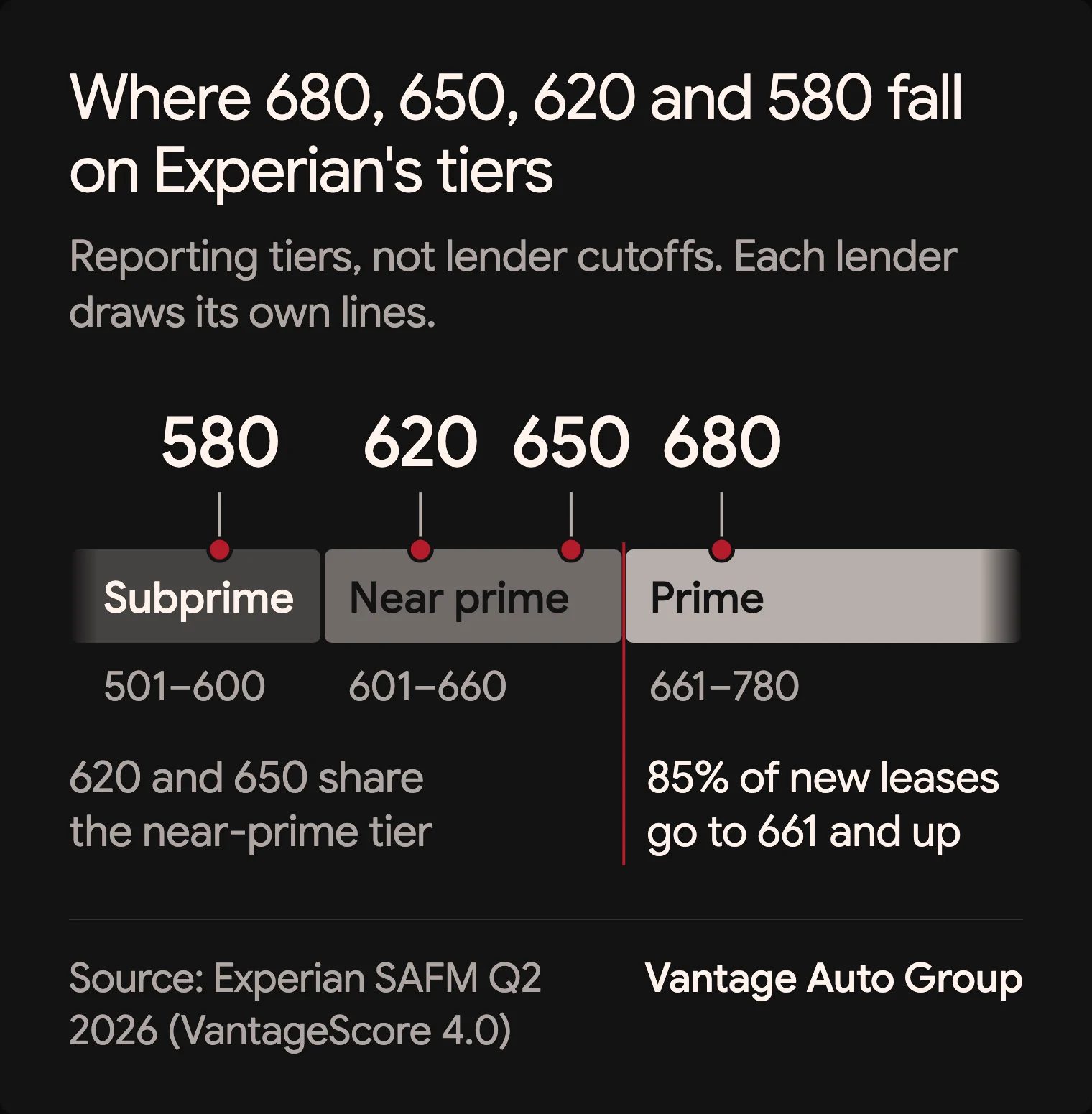
Leasing is realistic at 680 and 650, harder at 620 and uncommon at 580. Here is what each of those scores usually means, using Experian's tiers as the yardstick. Experian reports each tier's share of leases, not approval rates, so read these as market patterns, not odds.
680: prime, but not top tier
A 680 sits in the prime range (661–780), which together with super prime covers about 85% of new leases. You should have real options. The catch is that the payment in a manufacturer ad is usually priced for top-tier credit, so your money factor may come in above the advertised one.
650: near prime
A 650 falls in the 601–660 band, which accounted for 10.66% of new leases in Q2 2026. Leasing is realistic. Expect a higher money factor than the ad, and be ready for a lender to ask for something extra, such as a refundable security deposit, more due at signing or a co-signer.
620: the low end of near prime
At 620 you are still in the same Experian tier as 650, but at its bottom edge, where a lender's own cutoff may fall on either side of you. Fewer programs fit, and conditions like more due at signing or a co-signer become more common. Small score gains before you apply can matter most here.
580: subprime
Scores of 501–600 accounted for 3.79% of new leases, so it happens, but many standard programs are out of reach. The usual routes are a co-signer with strong credit or waiting a few months while you fix what is pulling the score down. Our guide to leasing a car with bad credit covers those options in detail.
One important wrinkle: the number in your banking app may not be the number the lender sees. Experian's tiers use VantageScore 4.0. Many auto lenders use a FICO Auto Score, which runs from 250 to 900 instead of the usual 300 to 850. Ask which score the lender uses before you read too much into a single number.
How lease credit tiers actually work
Your score does not decide a yes or no on its own. It places you in a lender's credit tier, and the tier sets your money factor and any conditions. That is why the same person can get different answers from different lenders.
- Each lender draws its own lines. The manufacturer's own lending arm (the "captive" lender), banks and credit unions each set their own tier cutoffs, and they use different scoring models. A score that is top tier at one lender can be a tier lower at another.
- The best lease specials usually run through the captive. Manufacturers often subsidize lease deals through their own captive lenders, and the fine print typically limits the advertised payment to well-qualified lessees with approved credit. If you are not in the top tier, that exact payment may not be available to you, but the same car may still lease at a different money factor.
- The score is not the whole file. Lenders also look at things like your payment history on past car loans or leases, your income against your debts and how long your credit history is. A thin file with a decent score can be harder to place than a thicker file with a slightly lower one.
- The money factor is the price of your tier. It sets the rent charge, the lease's cost of money, and a lower money factor means a lower monthly payment. On the same car, a money factor of 0.00332 instead of 0.00166 doubles the rent charge. Ask what money factor your tier qualifies for and check it against your paperwork. Our money factor guide walks through the math.
This is the part most shoppers never see. When one dealership says no, it usually means that lender's program did not fit your profile, not that leasing is off the table.
Not sure which tier you are in? Tell us roughly where your score sits, the car you want and your target payment. A quote request is not a credit application. Request a Quote
How to improve your odds before you apply
The fastest wins are fixing report errors and paying down card balances, and both are in your control. Here is a practical order:
- Pull your free credit reports. You can get free reports from Equifax, Experian and TransUnion at AnnualCreditReport.com. Dispute any account that is not yours, any wrong balance or any late payment you know you made on time.
- Pay down credit card balances. Amounts owed, which includes how much of your available credit you are using, make up about 30% of a FICO Score. Lower balances before the lender pulls your credit.
- Do not open new accounts right before you apply. New credit and fresh inquiries can nudge a score down at exactly the wrong moment.
- Keep your applications close together. According to the CFPB, credit checks for the same type of loan within 14 to 45 days of each other generally count as a single inquiry, depending on the scoring model. Shopping that drags on longer can count as several.
- Consider a co-signer carefully. A co-signer with strong credit can help you qualify, but they become legally responsible for the payments if you do not pay. The FTC's co-signing guide spells out what they are agreeing to.
- Pick the car to fit the tier. If your money factor will be higher, a vehicle with a strong residual value and a lower price keeps the payment reasonable. See what a good lease payment looks like in 2026.
What changes your lease payment besides your credit score
Credit sets your money factor, but four other levers move the payment just as much:
- Capitalized cost: the negotiated price of the car. It can be negotiated at any credit tier. Here is how lease negotiation works.
- Residual value: the car's estimated value at lease end, set by the leasing company when the lease starts. For most new-car leases that is the brand's own captive lender, so different lenders can assign different residuals to the same car. A higher residual means a lower payment.
- Due at signing: paying more up front lowers the monthly number, but it is money you hand over on day one.
- Term and mileage: the average new lease ran about 36 months in Q2 2026. More miles per year lowers the residual and raises the payment.
How a broker helps match your credit to the right program
A broker cannot change your score or approve credit, but a broker can help you aim your application at programs that fit your profile instead of applying blind. Vantage Auto Group is a licensed New Jersey auto broker, not a dealership or a lender. We work through our dealer-partner network, and the licensed dealership finalizes the contract and terms, subject to credit approval.
We start with a conversation, not a credit pull: your rough score range, the car you want and the payment you are aiming for. From there we can tell you which manufacturer programs may fit. Rates and approval are set by the lender when you formally apply through the licensed dealership, and you control when that step happens.
If your score sits near a tier line, we will tell you before you apply whether it is worth waiting a few weeks to pay down a balance.
We assist in negotiating, and we show you the full numbers before you decide anything. If you want to know what your credit range can realistically get, request a quote or browse current New Jersey lease deals. There is no obligation.