

For 2026, Section 179 lets a business expense up to $2,560,000, reduced once Section 179 property placed in service exceeds $4,090,000. SUVs outside the passenger-automobile limits and rated 14,000 lbs or less are capped at $32,000, except six-foot-bed pickups and certain vans. The vehicle must be bought, used over 50% for business and placed in service in 2026.
General information, not tax advice. Confirm your situation with a qualified tax professional.
How Weight Rating Decides Your Section 179 Limit
If you are a business owner shopping for a vehicle that qualifies for the Section 179 deduction, the numbers that matter most are the vehicle’s weight rating and its body layout. The tax code’s “passenger automobile” test is 6,000 lbs: for a truck or van it uses gross vehicle weight (GVWR), and for other vehicles, such as cars, it uses unloaded gross vehicle weight. A vehicle outside that definition escapes the low annual depreciation caps. A second threshold then applies: a vehicle outside the passenger-automobile limits that is designed or can be used to carry passengers and is rated 14,000 lbs gross vehicle weight or less is a sport utility vehicle for Section 179, limited to the $32,000 cap unless an exclusion applies: a cargo bed of at least six feet not readily accessible from the passenger compartment, an enclosed cargo area with no seating behind the driver, or seating for more than nine behind the driver.
Below: which limit applies to which kind of vehicle, the eligibility rules, then example models by category. To check a specific model’s weight rating, see our list of vehicles over 6,000 lbs GVWR by make and model. Buying in New Jersey? See Section 179 vehicles in NJ.
Want real numbers on your next car?
Tell us what you're looking for and we'll source your options across 350+ dealer partners. There's no obligation.
The 2026 Section 179 Limits, and the Deadline That Matters
For tax years beginning in 2026 the maximum Section 179 expensing amount is $2,560,000, reduced dollar for dollar once the cost of Section 179 property placed in service that year exceeds $4,090,000 (IRS Rev. Proc. 2025-32). Vehicles the tax code treats as sport utility vehicles carry their own separate cap of $32,000 for 2026.
The deadline is the part people miss. Section 179 applies to property placed in service during the tax year, not property ordered or paid for. For a calendar-year business, a vehicle bought in December but not delivered and put to business use until January counts for the following year. For a calendar-year business seeking a 2026 deduction, the vehicle generally needs to be placed in service by December 31, 2026 — which is why allocation and lead time start to matter well before then.
Separately, 100% first-year bonus depreciation applies to qualified property acquired and placed in service after January 19, 2025 (P.L. 119-21). Whether Section 179, bonus depreciation, or a combination produces the better result depends on your entity, income and other purchases — that is a question for your tax professional, not a website.
Which Section 179 Limit Applies to Your Vehicle
The weight rating and the body layout decide which 2026 limit applies. Every row after the first applies only to vehicles outside the passenger-automobile limits; a truck or van rated 6,000 lbs GVWR or less is generally a passenger automobile, whatever its body style.
| Vehicle type | Test | 2026 limit that applies | Source |
|---|---|---|---|
| Passenger automobile | A 4-wheeled vehicle made primarily for use on public roads and rated 6,000 lbs or less: unloaded gross vehicle weight for a car, gross vehicle weight for a truck or van | Depreciation, including any Section 179 deduction, capped at $20,300 in year one with bonus depreciation or $12,300 without; then $19,800, $11,900 and $7,160 a year | Rev. Proc. 2026-15; IRC §280F(d)(1), (d)(5) |
| Sport utility vehicle | A 4-wheeled vehicle designed or usable to carry passengers on public roads, not subject to the passenger-automobile limits (IRC §280F), rated 14,000 lbs gross vehicle weight or less, and not excluded below | Section 179 capped at $32,000 | Rev. Proc. 2025-32; IRC §179(b)(5) |
| Pickup with a six-foot bed | Open cargo area at least 6 ft interior length (or capped), not readily accessible from the passenger compartment | Not subject to the SUV cap; the overall Section 179 limit and the business-income limit apply | IRC §179(b)(5)(B)(ii)(II) |
| Enclosed cargo van | Integral enclosure of the driver and load area, no seating behind the driver’s seat, no body section more than 30 in ahead of the windshield | Not subject to the SUV cap | IRC §179(b)(5)(B)(ii)(III) |
| Large passenger van | Designed to seat more than 9 people behind the driver’s seat | Not subject to the SUV cap | IRC §179(b)(5)(B)(ii)(I) |
| Over 14,000 lbs GVWR | Rated over 14,000 lbs gross vehicle weight, so outside the SUV definition | Not subject to the SUV cap; the overall limit and the business-income limit still apply | IRC §179(b)(5)(B)(i) |
Section 179 Eligibility Rules for 2026
These apply to every vehicle type above.
| Rule | What it means | Source |
|---|---|---|
| More than 50% business use | You can elect Section 179 only if the vehicle is used more than 50% for business in the year it is placed in service. Only the business-use share of the cost counts, and the deduction can be recaptured if business use later drops to 50% or less. | IRS Pub. 946; IRC §280F(b) |
| Placed in service in 2026 | The vehicle must be ready and available for its business use during the tax year: by December 31, 2026 for a calendar-year business. Ordering or paying is not enough. | IRS Pub. 946 |
| Bought, not leased | Section 179 property must be acquired by purchase for use in your business. A vehicle you lease is not eligible, and neither is one acquired by gift, inheritance or from a related person. | IRC §179(d)(1)(C); IRS Pub. 946 |
| Overall dollar limit | $2,560,000 for tax years beginning in 2026, reduced dollar for dollar once Section 179 property placed in service that year exceeds $4,090,000. | Rev. Proc. 2025-32; IRS Pub. 946 |
| Business-income limit | The deduction cannot exceed taxable income from the active conduct of your trade or business; the excess carries forward. | IRC §179(b)(3) |
| Bonus depreciation | 100% for qualified property acquired and placed in service after January 19, 2025. Property acquired before January 20, 2025 follows the old phase-down rate. | Rev. Proc. 2026-15 §2.02; P.L. 119-21 |
2026 Section 179 Vehicle List by Category
The categories below show which rule usually applies. They are examples only: the weight rating and body layout of the exact vehicle decide the limit. For manufacturer-published GVWR by make, model and trim, see Cars Over 6,000 lbs GVWR: 2026 List by Make & Model.
| Category | Example models | Rule that usually applies | Confirm |
|---|---|---|---|
| Pickups | Toyota Tundra, Ram 1500, Toyota Tacoma (some configurations), Honda Ridgeline | If rated over 6,000 lbs GVWR: not subject to the SUV cap when the open bed is at least six feet long and not readily accessible from the cab; a shorter bed can put the truck under the $32,000 SUV cap | Bed length and weight rating |
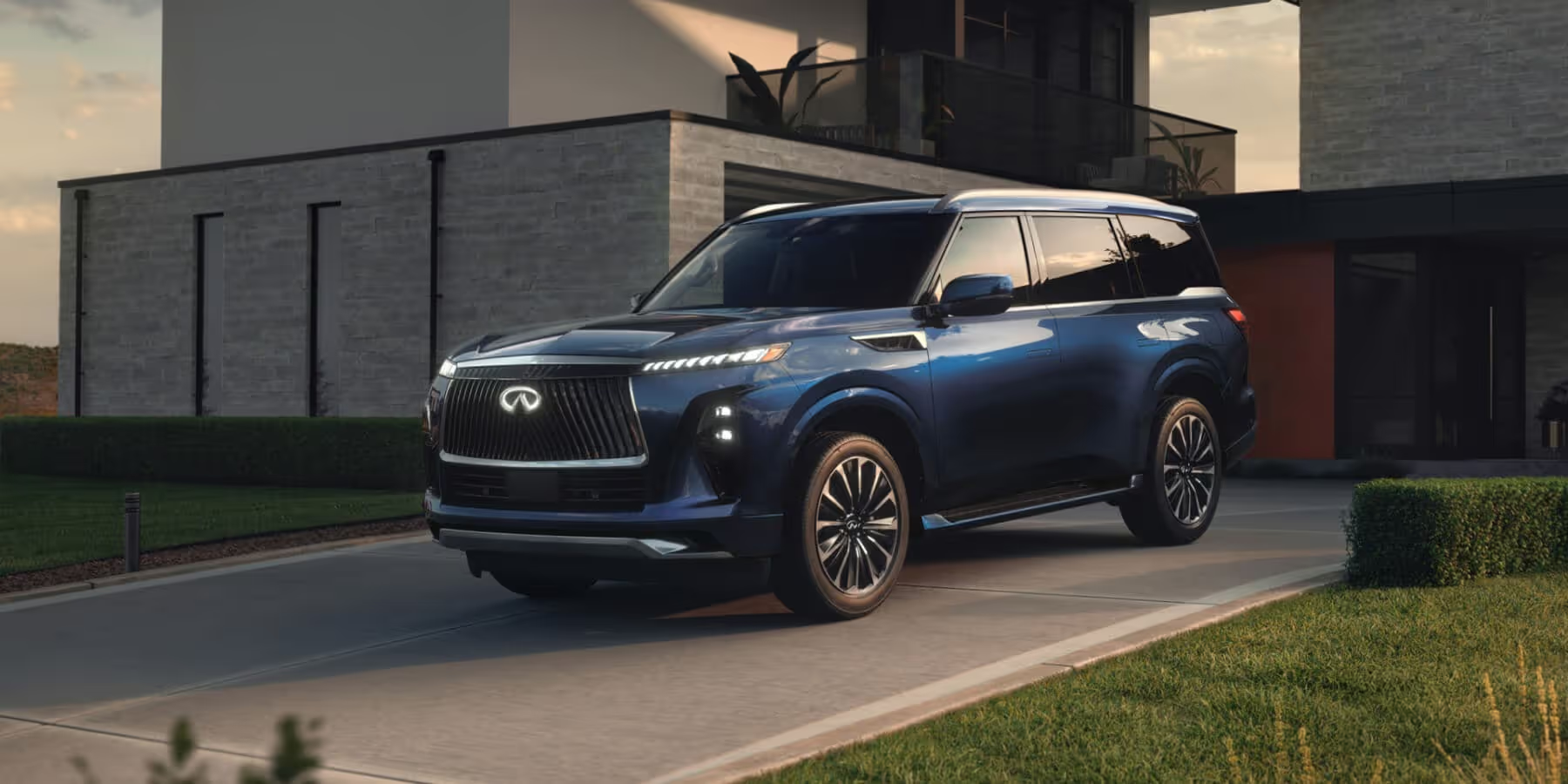
| Full-size SUVs | Toyota Sequoia, Toyota Land Cruiser, Nissan Armada, Infiniti QX80, Jeep Grand Wagoneer, Lexus LX, Lexus GX 550 | SUV cap ($32,000) if the vehicle is outside the passenger-automobile limits | Weight rating of the exact trim |
| SUVs near the line | Toyota Grand Highlander, Lexus TX, Jeep Grand Cherokee, Jeep Grand Cherokee L, Hyundai Palisade | SUV cap if outside the passenger-automobile limits; passenger-automobile caps if not | Trim-level weight rating, which varies |
| Electric SUVs and pickups | Kia EV9, Rivian R1S and R1T, Jeep Wagoneer S, Chevrolet Silverado EV (WT) | Same rules by body type (SUV or pickup). There is no federal clean-vehicle credit for vehicles acquired after September 30, 2025. See our list of electric vehicles over 6,000 lbs | Weight rating and bed length |
| Cargo and passenger vans | Ford Transit, Ram ProMaster, Mercedes-Benz Sprinter, Chevrolet Express | If rated over 6,000 lbs GVWR: a cargo van with no seating behind the driver, or a van seating more than nine behind the driver, is not subject to the SUV cap | Seating layout and body style |
| Heavy commercial | Chassis cabs, box trucks and other vehicles rated over 14,000 lbs GVWR | Outside the SUV definition; overall and business-income limits apply | GVWR on the label |
Important: some SUVs have trims on both sides of the 6,000 lb line. Always confirm the weight rating on the door-jamb label of the specific vehicle you are purchasing.
Vehicles Under 6,000 lbs: Subject to the Passenger-Auto Caps
These kinds of vehicles are usually at or under the 6,000 lb test and are subject to the lower passenger-automobile depreciation caps:
- Most sedans and coupes
- Most compact and midsize crossovers
- Some configurations of midsize pickups: several 2026 Toyota Tacoma configurations are rated 5,605–5,970 lbs GVWR
Passenger automobiles can still qualify for Section 179, but their depreciation, including any Section 179 deduction, is capped at $20,300 for the first year when bonus depreciation applies, and $12,300 when it does not, for vehicles placed in service in 2026 (IRS Rev. Proc. 2026-15; IRC §280F(d)(1)). Vehicles outside the passenger-automobile definition are not subject to those caps.
How to Get the Best Price on a Section 179 Vehicle
The tax deduction is only as good as the deal you get on the vehicle itself.
- Get quotes from multiple dealers before committing
- Negotiate the selling price, not the monthly payment
- Consider certified pre-owned vehicles (they qualify for Section 179 too)
- Time your purchase for end of quarter or model year for the best incentives
- Work with a licensed auto broker who knows which vehicles clear the weight thresholds
What Vantage Does Differently
We help NJ business owners source vehicles in the weight classes covered by these rules. When evaluating a vehicle for Section 179 eligibility, GVWR is one of the vehicle specifications that needs to be verified. Our vehicle search can help you compare options side by side.
We work with 350+ dealer partners to source the most competitive pricing available. All paperwork and final terms are handled directly by the licensed dealership.
Get a Free Quote and mention Section 179. No spam. No pressure. Unsubscribe anytime.
This is general information about how the federal rules work, not tax advice. Vantage Auto Group is a licensed auto broker, not a tax adviser. Your own treatment depends on your entity and circumstances. Confirm it with a qualified tax professional.
Sources: IRS Publication 946 (What’s New for 2026); Rev. Proc. 2025-32 §3.24; Rev. Proc. 2026-15 Tables 1–2; 26 U.S.C. §179; 26 U.S.C. §280F; IRS clean vehicle tax credits.







.jpg)