Why People Want Out of Their Lease
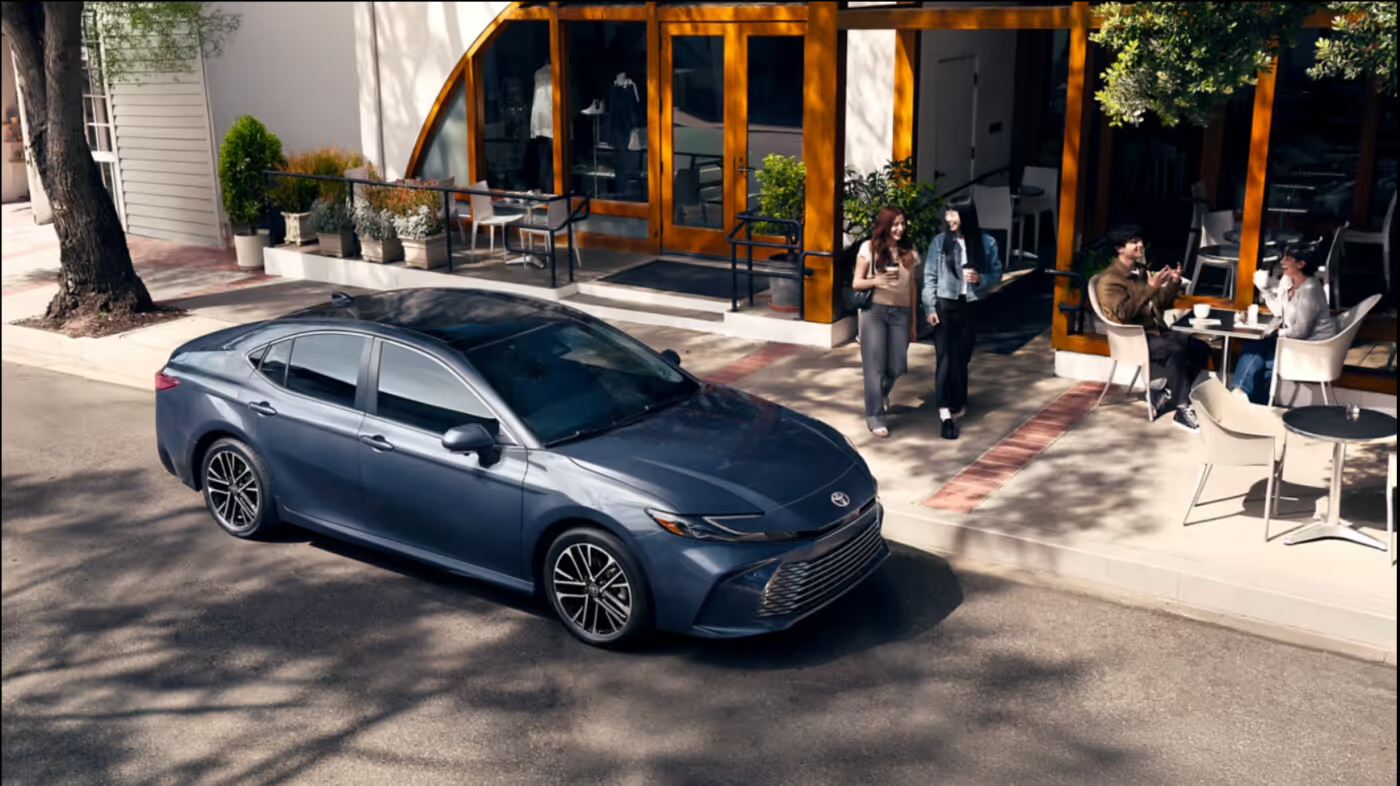
Life changes. You got a new job with a shorter commute and no longer need the car. Your family grew and you need something bigger. You are paying too much for a vehicle you do not love. Or the financial picture shifted and the payment no longer fits your budget.
Whatever the reason, you signed a contract, and breaking it has consequences. But "consequences" does not mean you are trapped. There are several ways to exit a lease early, and some of them cost less than you think. A few can even make you money.
Option 1: Transfer Your Lease
A lease transfer (also called a lease assumption or lease swap) lets you find someone else to take over your remaining lease payments. You transfer the contract to them, they pick up where you left off, and you walk away.
How It Works
- Check with your leasing company to confirm they allow transfers (most do, but some like BMW Financial restrict them)
- List your lease on a marketplace like Swapalease or LeaseTrader
- A buyer applies and gets approved by the leasing company
- The leasing company processes the transfer (fee: $100 to $500)
- The new lessee takes over payments, mileage, and end-of-lease responsibilities
Cost
The transfer fee itself is $100 to $500. You may also need to offer a cash incentive to attract a buyer, especially if your payment is above market rate or you have limited miles remaining. Total cost: typically $500 to $2,000, far less than an early termination penalty.
The Catch
Some leasing companies keep you on the hook as a co-signer even after the transfer. This means if the new lessee stops paying, you are still responsible. Check your lease agreement and ask the leasing company directly whether the transfer fully releases you from liability.
Option 2: Buy Out and Sell
Every lease has a buyout price, the amount you can pay to purchase the vehicle outright at any point during the lease. If your car's market value is higher than the buyout price, you have equity. You can buy the car and immediately sell it for a profit.
How to Check for Equity
- Find your current payoff/buyout amount by calling the leasing company or checking your online account
- Get your car's market value from KBB, Edmunds, or by getting offers from CarMax, Carvana, or a local dealer
- If the market value exceeds the buyout by more than the sales tax and fees you would pay to purchase, you have actionable equity
Example
- Buyout price: $22,000
- Sales tax on buyout (NJ 6.625%): $1,458
- Market value (CarMax offer): $26,000
- Net equity: $26,000 - $22,000 - $1,458 = $2,542 in your pocket
This only works when the market value exceeds the buyout plus tax and fees. In the current market, many leased vehicles have positive equity because used car values remain elevated. Check your numbers before assuming you are stuck.
Important Note
Some manufacturers (like GM and Stellantis) have restricted third-party buyouts, meaning you cannot sell the vehicle directly to a dealer like CarMax without buying it first yourself. You would need to purchase the car, pay sales tax, get it titled in your name, and then sell it. Factor those costs into your equity calculation.
Option 3: Trade It In at a Dealer
If you want a new vehicle, a dealer can handle your lease exit as part of the trade-in process. The dealer pays off your remaining lease (or buyout) and applies any equity toward your new purchase. If you are underwater (owe more than it is worth), the negative equity rolls into your new loan or lease.
When This Works Well
- You have positive equity in your lease
- You were planning to get a new vehicle anyway
- The dealer is offering strong incentives on the new vehicle that offset any negative equity
When This Is Risky
- You are rolling significant negative equity into a new loan
- The dealer uses the trade to obscure unfavorable terms on the new deal
- You are extending your loan term to keep payments low while burying negative equity
If you go this route, negotiate the trade-in value and the new vehicle price as separate transactions. Do not let the dealer blend them into one number on a four-square worksheet.
Option 4: Early Termination
Your lease contract includes an early termination clause that spells out what you owe if you end the lease before the scheduled date. This is typically the most expensive way to exit because the penalty is designed to make the leasing company whole.
What You Will Owe
- All remaining monthly payments (or a portion, depending on the contract)
- An early termination fee ($200 to $500)
- Any unpaid taxes and fees
- Disposition fee ($300 to $500)
- Excess mileage charges if applicable
- Excess wear and tear charges
On a lease with 18 months remaining at $450 per month, the termination cost could exceed $9,000 before any additional fees. This is almost always more expensive than a transfer or buyout-and-sell strategy.
When Early Termination Makes Sense
Rarely. The only scenario where straight early termination is reasonable is if you have very few payments remaining (two to three months) and the total cost is manageable. For longer remaining terms, explore transfers and buyouts first.
Option 5: Wait It Out
Sometimes the best strategy is no strategy. If you have six months or less remaining on your lease, the cost of exiting early may not justify the savings. Keep making payments, return the car at lease end, and move on.
During this time, minimize your driving to stay under the mileage limit and avoid any damage that could trigger excess wear and tear charges at turn-in.
Option 6: Negotiate with the Leasing Company
This option is underutilized. If you are facing financial hardship, call the leasing company and explain your situation. Some companies will work with you on modified payment plans, deferred payments, or reduced early termination penalties. They would rather work something out than deal with a default or repossession.
This is not guaranteed, and it depends on the company and your account history. But it costs nothing to ask, and the worst they can say is no.
How to Choose the Right Exit Strategy
Start by answering these questions:
- How many payments remain on your lease?
- What is your current buyout price?
- What is the car's market value? (Get offers from CarMax, Carvana, or KBB)
- Does your leasing company allow lease transfers?
- Are you planning to get a new vehicle, or do you just want out?
If you have equity, buyout-and-sell is often the best play. If you do not have equity but your company allows transfers, that is your next best option. If neither works, evaluate the early termination cost against the cost of waiting it out.
How Vantage Helps with Lease Exits
We help clients evaluate their lease exit options every week. We calculate the equity position, compare exit strategies, and handle the logistics of transfers, buyouts, and trade-ins. If you are considering a new vehicle as part of the exit, we negotiate that deal too, ensuring the numbers work across both transactions.
We also offer LeasePass, a lease exit protection product that gives you flexibility from day one. With LeasePass, if your circumstances change, you have a structured path to exit your lease without the typical penalties.
What Is the Catch?
Lease exits always involve some cost. Even the cheapest option (a transfer) has a fee. We are transparent about the costs of each strategy, and if the math says you are better off waiting, we will tell you. Vantage charges a broker fee for our services, but we only recommend a course of action if the total outcome is better than what you would achieve on your own.
The Bottom Line
Getting out of a lease early does not have to crush you financially. Check your equity, explore transfers, and know your termination costs before making a decision. The worst thing you can do is panic and accept the first option presented without comparing alternatives.
Need help figuring out your best exit? Get your free quote from Vantage in 5 minutes and we will evaluate your lease and recommend the most cost-effective strategy. No spam. No pressure. Unsubscribe anytime.


.avif)


.avif)