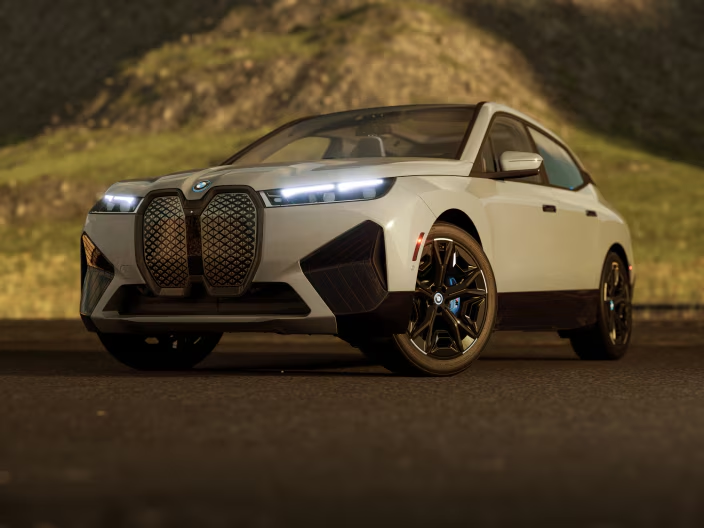
Short answer first, because you probably do not have all day. The choice between a hybrid and a fully electric car comes down to three things: whether you can charge at home, how far you actually drive in a normal week, and how often you take long road trips. Get those three answers straight and the right car mostly picks itself. Everything else is detail.
I am going to walk through it the way I would if you were sitting across from me. No dealership pressure, no pretending one answer fits everyone.
First Question: Can You Charge Where You Park?
This is the single biggest factor, so start here. If you own your home and can plug in overnight, a fully electric vehicle suddenly makes a lot of sense, because you wake up every morning with a full battery and you almost never think about fuel. If you park on the street, live in an apartment without a plug, or share a driveway with no outlet, a full EV becomes a daily logistics puzzle. That does not automatically rule it out, because workplace charging or a reliable fast charger nearby can bridge the gap, but you need a real plan, not a hope.
A hybrid asks none of this of you. You fill it at any gas station, exactly like the car you have now, and the electric side works quietly in the background to stretch your miles. If home charging is off the table, a hybrid is usually the honest recommendation.
Want real numbers on your next car?
Tell us what you're looking for and we'll source your options across 350+ dealer partners. There's no obligation.
Know What You Are Actually Comparing
People say "hybrid" and mean three different things, so let me line them up:
- Regular hybrid (HEV). A gas engine plus a small battery that recharges itself as you drive and brake. You never plug it in. Great mileage in city and stop-and-go traffic, and zero range anxiety.
- Plug-in hybrid (PHEV). A bigger battery you can charge for a modest all-electric range, often enough to cover a short commute on electricity, then the gas engine takes over for longer trips. It is the middle ground for people torn between the two.
- Fully electric (BEV). No gas engine at all. You charge it, and that is your only fuel. Lowest running cost and the quietest drive, but your day has to fit its range and your charging setup.
When the title of this post says hybrid vs. fully electric, the plug-in hybrid is the quiet third option that settles a lot of arguments.
Match the Car to How You Drive
Pull up your typical week honestly. If you mostly do short local trips, the school run, errands, a commute under an hour, almost any of the three works, and a full EV shines because you rarely approach its range. If you regularly cover long distances or take frequent road trips where stopping to charge for twenty to forty minutes would drive you crazy, a hybrid or plug-in hybrid keeps things simple. You refuel in five minutes and move on.
Be honest about the road-trip question specifically. A lot of buyers talk themselves out of a great EV over the two long drives they take a year, and a lot of other buyers badly underestimate how often they actually leave town. Count the real trips, not the imagined ones.
Upfront Cost vs Running Cost
A full EV usually costs more up front than a comparable hybrid, and it usually costs less to run. Electricity per mile is generally cheaper than gasoline, and an EV has far fewer moving parts, so there are no oil changes and less routine maintenance. A hybrid sits in the middle: cheaper to buy than most EVs, excellent fuel economy, and maintenance close to a normal gas car.
The right way to think about it is total cost over the years you will own or lease the car, not just the sticker or the monthly payment. If you drive a lot of miles, the EV's lower running cost has more time to pay you back. If you drive fewer miles, the fuel savings matter less and the lower purchase price of a hybrid looks better. This is exactly the math a good broker runs with you instead of at you.
The New Jersey Reality
Two local factors matter here. First, winter. Cold weather trims an electric car's range, often by roughly a fifth or more once temperatures drop and the cabin heater is working hard. New Jersey winters are real, so if you buy a full EV, build in a range cushion and do not shop right at the edge of what you think you need. A hybrid barely notices the cold by comparison.
Second, the incentive picture, because it changed a lot and plenty of older articles still have it wrong. Here is the honest 2026 version. The federal EV tax credits are gone. The up to $7,500 credit on a new EV, the version leasing companies used to pass through, and the up to $4,000 used EV credit all ended for vehicles acquired after September 30, 2025 under the One Big Beautiful Bill Act. New Jersey also ended its EV sales tax exemption, so a full EV now pays the full 6.625% state sales tax, the same as a gas or hybrid car. The federal home charger credit has ended too, for equipment placed in service after June 30, 2026. The one incentive still standing in New Jersey is Charge Up New Jersey, a point-of-sale rebate worth up to roughly $4,000 on eligible new battery-electric vehicles priced at or below $55,000 MSRP, for buyers who qualify. It is funded by fiscal year and has paused before when the money ran out, so treat it as available only if it is currently funded, and confirm the status before you count on it.
So, Which One Should You Buy?
Here is the clean version:
- Buy a fully electric car if you can charge at home, your daily driving fits comfortably inside the range, and you want the lowest running cost and the quietest drive.
- Buy a regular hybrid if you cannot charge at home, you drive long distances often, or you just want big fuel savings with zero change to your routine.
- Buy a plug-in hybrid if you want to do most short trips on electricity but keep a gas engine for road trips, and you can plug in at least some of the time.
There is no universally best answer, only the best fit for your driveway and your week. Anyone who tells you otherwise is selling, not advising.
How Vantage Auto Group Fits In
This is exactly the kind of decision Vantage Auto Group exists to make easier. We are a licensed New Jersey auto broker, so instead of you driving lot to lot, we coordinate the search across our dealer network, run the real cost comparison between the hybrid and the EV you are weighing, and show you the actual numbers, including where a current New Jersey rebate does or does not apply. If you already know you want to go electric, start with our EV lease deals in NJ. If you want to understand how a broker works before you commit, here is how it works, plus more on what a New Jersey auto broker actually does for you.
Ready to compare a specific hybrid against a specific EV with honest numbers? Request a Quote and we will show you the real picture for available inventory.